Environment news
- Caring for Creation together10 February 2026
- Record your church’s energy use13 January 2026
- A greener and warmer winter for St Mary’s25 November 2025
- ‘The hymn books have sung again’18 November 2025
- Bats and hot chocolate at St James’ Quedgeley21 October 2025
- The Great Switch for Creation, green energy tariffs9 September 2025
- Liking the lichens in St Cyr’s ‘BioBlitz’18 August 2025
- Plant barrow partnership with the Men’s Shed18 August 2025
- Creationtide 2025: peace with creation12 August 2025
- EFT thanks – last chance to submit (via Erica)22 July 2025
- Roosts of refuge: helping baby bat pups22 July 2025
Be the change
In a crisis, everyone needs to pull together – climate change is no exception. As Christians, we have responsibilities as we live alongside all God’s creation. This is something that affects both people and the planet, the world’s poorest and all that God has made. We all need to act.
In the video above, Erica Sidall, our Net Zero Carbon Project Manager, shares a little about some of the changes we’ve been making to our offices to work towards the Eco Diocese Silver Award.
The crisis we are in can feel overwhelming. We might be wondering where we start, how we can help, what difference we can make? We all can make a difference, and it’s often taking the small steps that add up to create the big change.
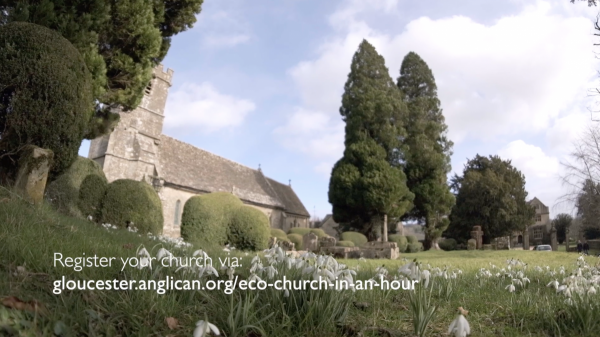
So that is why we are asking you register as an #EcoChurch.
This campaign, developed in the Diocese of Gloucester in partnership with A Rocha UK, breaks down Eco Church into small, manageable steps.
-
- Go online to the Eco Church website
- Add your church to the Sign up here: Eco Church Community
- Take the Eco Church survey
The survey will help you think through steps you can take to become an Eco Church, from simple things like using hymns and songs that celebrate God’s creation to creating a wildlife area in the churchyard. You never know, you might qualify for an award already, becoming an Eco Church in an hour.
We are working on the same thing in our diocesan offices at Church House in Gloucester. When we moved premises in 2025, we knew we wanted to prioritise sustainability. Energy management was a key consideration in how the new Church House was refurbished. We completed the same Eco Church survey as everyone else, so we have seen how simple the process can be, and found that we were close to a silver award without knowing it. The Eco Church scheme is on of the main ways we bridge the gap between our hopes and dreams for caring for creation, and knowing what practical steps to take on the ground.
We are calling on all worshipping communities to be the change and take part in #EcoChurch. We’ll be sharing simple, achievable steps that we and other people have taken to help get an award.
Roger from Edgeworth found on registration for Eco Church that his church had already achieved a bronze award. “It’s not as complicated as I thought it was going to be.”
Register online via EcoChurch.org
Through this simple online system, churches can sign up to work towards a Bronze, Silver or Gold award. It takes no more than an hour to do. You never know, you might qualify for an award already, becoming an Eco Church in an hour. An award is granted when a church meets certain requirements for demonstrating care for the environment, parish and community. To gain an award, a church will need to be considering environmental matters under the following headings:
- worship and teaching
- buildings
- land
- community and global
- lifestyle.
Once registered, do check out the resources section of the website.
We also have a Facebook group for anyone who is interested in Eco Church in the Diocese of Gloucester. If you are the Eco Church Lead at your church please let us know by completing this short form. Also, please do join our online community.
It is important that care for the environment is included in our worship and teaching so that Christians are supported to grow in understanding of this as a deeply biblical concern.
 Many churches have a focus on the environment during Creationtide which runs from the Orthodox New Year on 1 September until St Francis Day on Thursday 4 October. This includes Harvest festivals but can also be a full month of environment-themed worship or special events that include the wider community.
Find out more about Creationtide
Resources for worship including the Agricultural Year
National CofE worship and teaching resources
Preaching on the environment through the lectionary (Greening our Preaching)
Preaching on the environment through the lectionary (Preaching for God’s world)
Planet Protectors resource for children,
Daily prayer for the Climate Emergency from Tearfund
Doxecology – a collection of newly written Christian songs with an environmental theme. Or for those that prefer hymns, these creation themed new words for familiar tunes may be of interest.
Worship outdoors – is growing in popularity, whether using the term Forest Church or other similar (Muddy Church, Outdoor Church, Wild Church…) resources for churches wanting to explore outdoor worship.
Churches are often responsible for churchyards (and sometimes other land) and choices can be made to manage it to encourage wildlife and biodiversity, balancing this with existing uses of the space.
If you’re working with the wider community on wildlife-friendly management of community green spaces, this can also be part of work for the Community and Global heading of Eco Church.
Check out whether there are any churchyard regulations relating to changes you are planning: churchyard regulations
Caring for God’s Acre is a dedicated charity focussed on managing churchyards for wildlife: www.caringforgodsacre.org.uk
Gloucestershire Wildlife Trust has some great resources for wildlife gardening, many of which are applicable to churchyards as much as gardens: www.gloucestershirewildlifetrust.co.uk
For those churchyards with ancient trees to manage www.ancienttreeforum.co.uk
Our diocese has small grants of £250 available to churches for wildlife-friendly management of churchyards and wildlife gardens: www.gloucester.anglican.org/grant-aid-for-wildlife-gardens
Diocese of Gloucester DAC & buildings team
Our buildings team is committed to supporting churches to make sustainable choices for their buildings. Keeping church buildings in good repair reduces energy consumption. The 2020 Environmental Policy is available on the DAC web page.
National Church resources on sustainability
Energy Footprint Tool (EFT)
Webinar series on getting to net zero
The practical path to net zero
Practical path to net zero summary document
DAC recommends:
Arthur Rank Centre: sustainability resources
National CofE: Energy Efficiency Guide
Faith in Maintenance calendar
Webinars on carbon net-zero – these are offered by the National CofE as a result of the General Synod aim to achieve carbon net-zero by 2030. The energy footprint tool (EFT) is important for keeping track of progress towards carbon net-zero. Green Energy deals – these are available to churches seeking good options with a green energy provider.
Our responsibility as Christians is wider than our local buildings and land. It’s also about how we live with the wider community, nationally and globally.
Eco Church resources include engaging with local sustainability groups and writing to an MP.
Christian Climate Action is involved in political campaigning
Gloucestershire Churches Environmental Justice Network often shares helpful material.
Tearfund and Christian Aid are international Christian charities with helpful resources, addressing the impact of climate change on the global poor.
Eco Church encourages us to challenge each other on sustainable choices in daily life as well as what we do together as the Church.
Eco Church has a variety of resources covering concerns such as travel, food, energy and waste.
This lifestyle audit is among other listed resources
Household quotes is a list of ideas for reducing personal carbon footprint.
The Green Christian website has a variety of resources concerning personal lifestyle commitments.
Wild Christian is a community of families and individuals exploring the connections between our Christian faith, the natural environment and how we live.