
Paul writes to the Philippians: ‘I thank my God every time I remember you, 4 constantly praying with joy in every one of my prayers for all of you, 5 because of your sharing in the gospel from the first day until now. 6 I am confident of this, that the one who began a good work among you will bring it to completion by the day of Jesus Christ’. (Philippians 1: 3-6)
As we venture into the autumn and look back over those long, hot summer months, for me there have been many places of joy and delight AND plenty of difficult and painful places, yet just as the apostle Paul in those opening verses of Philippians looks back with thanksgiving (even when imprisoned), there is so much I want to give thanks for across our diocese over these past months – and for me, book-ended by key events in the cathedral which were significant statements of our LIFE together:
Just as we marked the official start of summer in June, we had the services of ordination. It is always such a privilege to ordain new deacons and priests full of excitement and expectancy in responding to God’s call. And as I repeatedly say, those services of ordination are about the whole people of God, as captured in those introductory words at the beginning of every ordination service: ‘The Church is the Body of Christ, the people of God and the dwelling-place of the Holy Spirit. In baptism the whole Church is summoned to witness to God’s love and to work for the coming of God kingdom…To serve this royal priesthood, God has given a variety of ministries…’
And so, it was extremely good to mark the official end of summer in September, with a service to celebrate lay ministry, focusing on the truth that ‘To serve this royal priesthood, God has given a variety of ministries…’.
Those services in the Cathedral, bookending the summer, all reflected our LIFE Together spotlight commitment to ‘develop diverse lay and ordained leaders.’
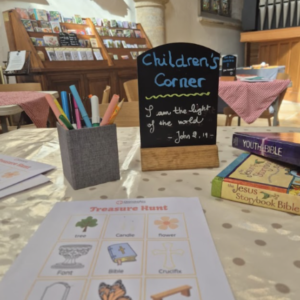
One of the many things I delighted in across all those services was the presence and participation of children and young people, including all those children and young people singing in the cathedral choirs.
And of course, every person present in those services who was not a child, was once a child, just as is the case when we gather for worship in so many different contexts.
Perhaps that’s stating the obvious, but sometimes it is easy for us to talk about children and young people as if they are some special sort of breed rather than recognising we were all born as babies and grew up as children and young people. I love those words in that ancient well-known Psalm 139: ‘For it was you who formed my inward parts; you knit me together in my mother’s womb…’ Each of us here was once a child, and is still a child – a child of God.
So much that we carry as adults was shaped in childhood – that which is beautiful, that which is ugly; that which gives us joy and that which gives us pain. I wonder how good we are at reflecting on that and asking what that might mean for us as a Church – for church leaders and for the whole people of God?
When we last met in July, I spoke about how in our desire to join in with that kingdom of God vision of transformation, we need a much greater culture shift to intentionally place the child at the centre:
Some verses from Mark 9 (35 -37): ‘Whoever wants to be first must be last of all and servant of all.’ Then he took a little child and put it among them; and taking it in his arms, he said to them, ‘Whoever welcomes one such child in my name welcomes me, and whoever welcomes me welcomes not me but the one who sent me.’
A much greater culture shift to intentionally place the child at the centre is not about children and young people’s ministry sitting in a separate box over there, rather it is about how our commitment to discover and share Christ’s life in all its fullness means a deep commitment to each generation and the generations yet to come – together.
This is woven-in throughout the Old Testament and Jewish teaching. Psalm 78 is just one psalm where this is writ large: ‘We … will tell to the coming generation the glorious deeds of the Lord and his might and the wonders that he has done. … that the next generation might know them, the children yet unborn, and rise up and tell them to their children, so that they should set their hope in God, and not forget the works of God, but keep his commandments…” (Psalm 78:4-7)
One of the great privileges being on retreat with the ordinands, is having the opportunity to hear something more of their stories and what has brought them to this place. Those stories often touch on encounters in childhood or young adult hood – and I am always struck by the influence of key Christian adults. This year I heard two moving stories of the influence of Christian teachers.
Sometimes the stories are about someone as an adult being drawn into a worshipping community through bringing a child to baptism, or having a curious child who asked the now-ordinand to take them to church.
If we look at who we are as Church, locally and in all our different contexts (our prayer and worship, and where we focus our time and energy; how we engage with our local communities, and nurture one another in the living out of our everyday discipleship), what does that mean for children and young people, families and carers?
If we look at the work of our schools; the ministry and work of Sportily and Grace Network; the work of the Church Development Agency; our balance sheets and our deployment of clergy and lay leaders; the use of our church buildings … How is all this investing in the flourishing of children and young people – in the present and for the future?
And let me quickly add that I do not believe this is about the Church taking on the role of social services or children’s services (although I do believe we often need to be relating to all those bodies). Our LIFE Together Heading of ‘E’ for Engagement and our commitment to ‘Being advocates for flourishing’ does not stand separately from our commitment to our F Heading of ‘Faith’ as we live confidently as adventurous followers of Jesus Christ. So, in our desire for the flourishing of every child, young person and family, we long for everyone to encounter Jesus Christ and grow in faith, keeping our eyes on the big vision of the coming in of God’s kingdom as we respond to that summons to witness to God’s love.
I think the Church of England vision for education captures it well in that overarching title: ‘Deeply Christian, Serving the Common Good’.
Of course, we are not the ones who make those encounters with Christ happen – that is the work of the Holy Spirit. And there are children and young people who encounter the already-present Christ in mysterious and wonderful ways which seemingly did not involve any church programmes or initiatives. A number of you have stories to tell of young people finding their way to church simply because the Holy Spirit continues to be at work.
Yet, we do also need to go on thinking about, and creating, those spaces and places where the love and hope of Jesus Christ is lived and shared with those with babes in arms, and toddlers, and through every stage of childhood through to young adult hood (and of course beyond).
In all of this, I continue to note not only in different bits of research, but also in my own engagement with children and young people, that there is a hunger for the mystery of God, and an openness to hear about Jesus Christ in a way that is perhaps different from even ten years ago. Whilst so many older Christinas are often reticent about sharing faith, children and young people want to know about Jesus and what we believe. They are hungrily exploring different sources of spirituality – searching social media and asking AI. They are longing for mystery, and they are longing for deep relationship.
Of course, there is always paradox: Yes, as adults we have a responsibility to share our faith in Jesus Christ with children and young people, but we also need to listen and learn from children and young people, not least those who are already growing in faith and have much to offer and teach those of us who are adults.
The body of Christ is lacking if it is not intergenerational and diverse, growing together in our discovering and sharing of Christ’s life in all its fulness.
So Synod, are we up for being yet more imaginative and learning from one another across the diocese? And are we willing to constantly challenge that narrative which is so prevalent among adults who too easily see church as being an adult space with an add-on to do things for children and young people, and living out a desire to primarily draw children and young people into what the adults have already shaped and decided is the right way to ‘do church’.
I’ve mentioned the beginning and end of summer, and in a matter of weeks it will be advent and we will hear again the words of the Old Testament prophets pointing us to that vision of transformation and restored relationship as the Kingdom of God is brought to fulfilment – visionary verses such as those from Isaiah 11: ‘The wolf shall live with the lamb, the leopard shall lie down with the kid, the calf and the lion and the fatling together, and a little child shall lead them’.
A little child shall lead them.
At our Synod gathering in July when we were joined by parents and teachers and young people who are not already members of Synod, we had some simple roundtable discussions just to get us thinking about that culture shift if we truly put the child at the centre as we live our LIFE Together five spotlight commitments. It was not meant to be a comprehensive and extensive exercise but rather something to get us thinking creatively and differently; and of course, remembering that just as all adults are different, so too there is not a homogenous group called ‘children’ or ‘young people.’
I’m hoping that in our local contexts, people will increasingly be finding ways to include children and young people in decision-making. For example, how might PCCs and Bishop’s Council make use of our local school councils and hear from them? I’m also hoping that worshipping communities will take a fresh look at where children and young people gather across our local contexts, and ask how or if we are engaging in those places.
It’s also important to be aware that whilst so many of us who are adults think in terms of churches, parishes and deaneries when it comes to our identity, belonging and planning, that’s not usually the case for many children and young people who may more readily see their identity and belonging as bound up in the places where they gather, not least schools. For example, a child or young person may more readily identify as being a being a student here (All Saints Academy) or being a member of say Cheltenham Junior Football Club or Tewkesbury Young Farmers, rather than identifying deeply with a particular town, or village or parish. How might understanding how a child or young person sees their identity and belonging help those of us who are adults see differently in our engagement?
I’m delighted that from our spotlight commitment to ‘invest in people and programmes which excite young people to explore and grow in faith’, a pilot has emerged involving ‘school connectors’ being placed in four secondary schools.
It was so energising being in the Cotswold School two weeks ago with Tim Fletcher the new chaplain (aka as connector) – to see Tim building on strong relationships developed with that school over a number of years, and all that has already been enabled through the involvement of local clergy and the ministry of Amy Todd in her connector role. And then on the same day, it was good to be with the deanery clergy and lay leaders to see their investment in this schools ministry, and what that will lead to in connecting with worshipping communities, Sportily and more.
But back for a moment to the truth that all of us are shaped by our childhood, and our ongoing discovery of what it means to be children of God, and to be like the little child Jesus drew attention to – To be child-like.
Perhaps, as those of us who are adults endeavour to live our LIFE Together more intentionally placing the child at the centre, perhaps we need to be more deeply aware of the child within us and within the adults around us, and what that means for us as the Church. Perhaps we might be kinder and more compassionate with one another if we were curious with one another about our stories and saw each other as children of God.
(Although I do caveat that by saying we do need to have adult to adult interactions rather than what can sometimes be more like toddler tantrums or teenage strops!)
Finally, let me just say something about our vision of LIFE Together as we live this intentional culture shift to place the child at the centre (and by that, I mean the child and the young person).
It is nearly ten years since our LIFE vision emerged from prayer and conversation. Then five years later in 2022, after listening to stories emerging from across the diocese, there was a sense that whilst all the things we identified as commitments under our life headings in 2016 were all still relevant, the Holy Spirit was shining a light on five particular areas where we needed to have a more focused commitment (If you’ve been playing LIFE Together bingo, you will have noticed that I have referenced them all in passing today). So, in 2022 we moved into a new season of LIFE Together – All of it still rooted in those words of Jesus Christ from John’s gospel ‘I have come that they may have life and have it to the full.’ (John 10:10)
I am aware that ten years is a long time. In terms of what we have been speaking about, many children have been born, grown up, had children of their own; and many of our current clergy and lay leaders were not around when we lived that discernment process in 2016; and thank God that since then new people have become part of our worshipping communities; people have come to faith and many children and young people and adults have been baptised. Across the diocese much has been planted and watered and brought to fruition – and of course there have also been places of stony ground and choking thistles.
I believe it is now time to look back as we look forward. In that same spirit of Paul writing to the Church in Philippi, to look back at our LIFE vision with thankful hearts and to recognise, note and remember all that God has done through the work of the Holy Spirit in us, around us and through us, in our local contexts and across the diocese; and then to look with hope to the future and ask where God is leading us next, to, as Paul writes, ‘determine what is best.’
I’m aware some of this has already been happening in the development of the deanery strategic pathways … (Incidentally, it’s been exciting to see how those pathways have identified that intentional focus on children and young people).
I’m not envisaging some big, structured review process, but rather some sort of simple framework to encourage worshipping communities and different expressions of church to take the four big headings of LIFE plus the five spotlight commitments identified in 2022, and to identify those things (that planting, that fruit) for which you want to give thanks to God; and then to reflect, and prayerfully discern if what you are now inhabiting or being called to, still resonates with those five spotlight areas. Even if the vocabulary and the way you would articulate things is different, is the essence the same, or is there something where together across the diocese we sense the Holy Spirit to be at work which isn’t captured by these five commitments?
I’m hoping that gathering all of this from across the diocese will enable us to give thanks to God, to celebrate one another, and to be thankful for our partnership in the gospel as we look back and look forward…
So, in a little while we’re going to have some time around tables to ask how we might do this.
Before that, let me just recap on what I have said about recognising that we were all once children, and our different experiences have shaped who we are; that we remain children of God, and as members together of the body of Christ we are called to place the child at the centre as we seek the Kingdom of God.
Jesus Christ said, ‘Whoever welcomes one such child in my name welcomes me’. So, what might it look like to be Church across this diocese, placing the child and the young person at the centre as we seek to share the transforming gospel of Jesus Christ, and to discover and share Christ’s life in all its fullness? And for those of us who are adults, to walk our path of faith with children and young people, and learn from children and young people; and vice versa. Inhabiting LIFE Together across the generations and down the generations.
‘And this is my prayer, that your love may overflow more and more with knowledge and full insight to help you to determine what is best, so that on the day of Christ you may be pure and blameless, having produced the harvest of righteousness that comes through Jesus Christ for the glory and praise of God’. (Philippians 1:9-11)
AMEN

 News Hub