

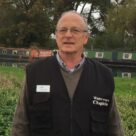
Charles Garven is a Waterways Chaplain and a Reader. He shares the everyday reality of his vocation as he lives, works and prays alongside the canal community.
“The work of Waterways Chaplaincy is to bring help and support to the people who live, work and play on the waterways of Britain. This ministry is more than just to the folk who live on the boats, but the canal workers, local businesses, fishermen and towpath walkers too. Nobody is excluded. The chaplains do not set out to be evangelists, they are ordinary people, just like you and me, but evangelism does become so much of what they do. I have been a Lay Reader for thirty years, but becoming a Waterways Chaplain is the first time I have ever really felt that I have been able to take the Gospel outside of the church and into my own neighbourhood.
“A summer walk along the towpath can be idyllic, or even a boat ride if you’re lucky enough. For those of us fortunate enough to own comfortable, well-proportioned boats, and who have sufficient incomes, it can feel a little like you are on holiday all year around. But not everybody is that fortunate. In among our gin-palaces there many others who really do struggle.
“A lot of people come to canal with a great sense of adventure, often looking for a new start in life and hoping for the romantic dream of a life on the water. Only for a very few do these dreams become a reality. High costs, the pressures of work and the need to be able to stay in one geographical area can so easily dash these hopes. For a few, these wonderful dreams become frequently misplaced in the struggles of daily life.

“The Waterways Chaplains try to stand on the bridge between the needs of the people and those who are able to help. We have no grants to hand out ourselves, but where we cannot help we frequently are able to signpost people towards those who can. Often a relationship might begin with a foodbank parcel, or assistance with energy bills, but over time this frequently will develop into a more meaningful friendship.
“We live by the motto ‘Pastorally proactive, spiritually reactive’. What this means in practice is that our first meetings with someone are at the point where their pastoral, or often practical, needs are foremost, and we offer help as best we can. But we will not ‘bible-bash’ unless our conversations naturally lead that way. If you try to ram the gospel down someone’s throat, they will likely choke on it. Instead we wait until we are asked, and then we are prepared and ready to answer any questions of a spiritual nature. Even then I try not to give the textbook answers. I simply try and explain what having a relationship with Jesus Christ has meant to me. That way I’m hopefully speaking from first-hand experience.
“Some of the stories I could tell are miraculous for their simplicity.
I met a man on the towpath, a while ago now, who lived alone on his boat, but with a small community of friends around him. He suffered from ADHD which prevented him from being able to work. He told me that his medication gave him depression — I guess this could be true. And so much of the little income he received was spent in the pub in an attempt to overcome the depression. It’s all too familiar a story.
On the day I first met him, he told me that he was wearing the only clothes he owned. Simple jeans and a jumper, and shoes with holes cut into the toes. “I have very large feet” he explained, “You can’t get size 14s in charity shops”. I was later that day able to place an appeal for clothes in our local church’s weekly news sheet.
A few days later I returned to this man’s boat. Thanks to the generosity of the people in local churches, I had been given five large bags of perfectly sized clothes including trousers, shirts, jumpers and underwear, much of which was brand new and had been bought especially for him. We had also been given a good winter coat, a homemade blanket and even a pair of size 14 trainers. The gratitude on his face was enormous. No one had ever done anything like this for him before.
“And again, on another occasion …
I came across a particular boat a few years ago. It was moored and looking abandoned along the towpath, with a Canal and River Trust enforcement notice attached. There was nobody on board, but other boaters had told me that there actually was someone living aboard. I simply left a leaflet with my phone number inside the cockpit.
Some weeks later I received a phone call, ‘You left a leaflet on my boat, can we meet up?’ We arranged to meet in a local café that weekend. In fact, we met up on several occasions and he even came to church a few times. After a while he began to bring his mother, his uncle, and once or twice even his daughter. There was great excitement when, after one of my own assuredly tedious sermons, he phoned me to say that they had stopped in a lay-by on the way home and his daughter gave her life to the Lord there and then.
Isn’t it funny how the Lord works? The boater used to say that I was helping him to rediscover the Christian faith that he used to have when he was younger. I thought we were just having coffee in a café!
He has since left the canal and got married. He invited my wife and me to his wedding. He wrote inside the invitation that “I was the most influential person in his life in recent years”- Except for his lovely new wife, I guess!
“Poverty is a common problem. If you live aboard your boat you are classed as ‘having no fixed abode’. Without a postal address, you cannot have a bank account. Without a bank account you cannot get employment. Even receiving Universal Credit can be a problem. For many, this begins a downward spiral which leads to hunger, cold, and often very poor living conditions. I have hardly had a day since Christmas where I haven’t met someone who needs a helping hand. And I believe, I am only seeing the tip of a very large iceberg.
“I really do believe that chaplaincy in its many forms is having a major part to play in forming the future of the Church, and there is a real need for people to fulfil these roles. To remain effective, the Waterways Chaplaincy is going to need help from people who are willing to stand on that bridge between those who need help and those who are able to provide it. We need people who are willing to stand on that bridge between the love of God and his people.
“The help that you could give to the Waterways Chaplaincy could be threefold. Firstly, we need supporters who are willing to commit themselves to regularly pray for the Waterways Chaplains and the people we meet every day. These supporters could also act as a signpost for others to the Chaplaincy, should the need arise. Secondly, and for those who have a special talent, we have financial needs simply to keep the work of the Waterways Chaplaincy afloat. Thirdly, and most importantly, there is a desperate need for more Waterways Chaplains, people who are Christians and members of their own local churches who would like to be part of this very exciting story, and who can spare a few hours each week.”
Please get in touch either via the Waterways Chaplaincy website at www.watewayschaplaincy.org.uk or email Charles direct at moc.e1768932767vil@e1768932767nohpn1768932767evrag1768932767eht1768932767







 News Hub