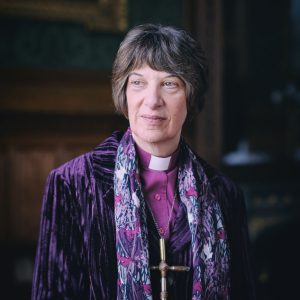
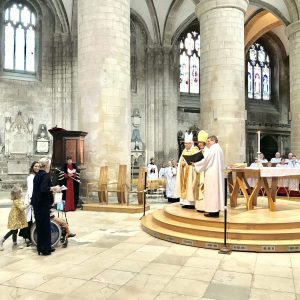
 The Bishop of Gloucester, the Rt Revd Rachel Treweek’s sermon at the Chrism Eucharist service in Gloucester Cathedral.
Chrism Eucharist 2 April 2026
Readings Revelation 1.5b-8 and Luke 7.36-50
What a mess! Those are my words as I look out at the mess and devastation of the ongoing war and conflict across what we call the Middle East and its far-reaching impact. And sadly, there are so many places of conflict across our world. What a terrible mess. And so much of it seems to stem from the action of leaders exercising their might and power and seeing everything from their perspective alone.
Disdain and judgement, sin and broken relationship, imbalance of power. Those things were actually also present in a messy scene in the home of Simon the Pharisee, as we heard in our gospel reading. Indeed, disdain and judgement, sin, broken relationship and an imbalance of power – all those things seem ever present across our world, both far away and close at hand, not least in the Church and in the stories of our own communities and lives. And we are called to minister amidst the mess.
Today I want to publicly thank Bishop Robert for responding to the call of God as this week he officially takes on the role of Lead Bishop for safeguarding. And across this diocese we are committed to listen, to care, to learn and to act.
As we gather today and say ‘yes’ to ministry amidst the mess of the world, I do want to say a loud thank you to each of you. I also want to acknowledge people’s tiredness (as well as energy!).
Ministry can sometimes feel relentless – particularly at those times when the narrative of decline and scarcity in the Church of England becomes loud, even as we continue to turn up the volume on the song of Jesus Christ’s kingdom-of-God transformation, in lives and communities. That doesn’t mean we don’t pay attention to some of the numbers as we use our power to use our resources well, but it does mean singing God’s song of abundance, even in places of lament.
Thank you to you for the many stories of transformation – small and large – which you carry into here today – stories which speak of the abundance of God’s love and grace…
That woman in Simon’s house encountered that as she wept, kissed, and lavishly poured out oily ointment and as she received the abundant and overwhelming love and forgiveness of God.
As we pray over oils today, we know that in their very essence they are messy, and they will be taken from here to anoint people at key points in the stories of their lives – baptism, confirmation, ordination, and those times of prayer for healing and at the point of death. With oily messy crosses we will enter into both the joy and the sadness of people’s lives as we proclaim the love of God revealed in Jesus Christ, through whom comes transformation and restoration.
But I do not want to sound trite – I am only too aware that sometimes transformation and restoration seem so distant, and life’s mess seems only to increase. Indeed, as I have been thinking about this service and the oils and where they come from, and as I have anticipated singing those words about the ancient olive root, I have found myself reflecting on a day in January when I was with two other bishops in the beautiful Makhrour valley in Bethlehem, planting olive trees on the land of a Christian Palestinian farmer.
It was a messy place, not just in terms of mud, but also emotionally, theologically and politically.
Olive trees are deeply significant to Palestinian life and identity, yet all that is constantly under attack with the misuse of power in a land under occupation and as Israeli settlers continue to violently invade Palestinian land. Only the day before we arrived, the olive trees of the neighbouring farmer had been destroyed. People’s ability to hope for restoration amid the mess and pain, seems to diminish by the day.
Yet in that place of mess and brokenness, there were seeds of hope. We were there alongside Israeli Jews at the invitation of an organisation called Rabbis for Human Rights – people across the spectrum of Jewish tradition who have courageously come together to use their power to act for good and justice.
That day, carrying our differences, we planted in solidarity. And in that place of relationship amid ugliness and mess, I truly sensed that we were using our power to join in with the powerful and restorative work of God – our God of relationship whose story spanning history is about reconciliation, sin forgiven, transformation and restoration – the power of God to make all things new. To repeat those words from the mysterious Book of Revelation: ‘“I am the Alpha and the Omega,” says the Lord God, who is and who was and who is to come, the Almighty’. (Rev 1:8)
Here is power and majesty beyond our imagining – The power which raised Jesus Christ from the dead. And I cannot grasp the mystery of God who shares that power with us and through us through the work of the Holy Spirit, as God’s story of restoration continues to unfold, even when the mess seems overwhelming.
Many of you will have heard before my criticism of a prevailing culture of ‘fix it’ that fails to first identify the ‘what’ of ‘what good might look like’ – what transformation could look like. For us as a Church, that means keeping our eyes on the big picture of kingdom of God restoration, rooted (to use those words from Revelation) in ‘the one who loves us and freed us from our sins… and made us a kingdom.’
And so, even here and now we need to use our imaginations to paint a picture of what hope-filled restoration could look like in the present in our different contexts, and then humbly to say ‘yes’ to joining in – using our power well, and that of our resources, even amid mess.
It is what I see in our gospel reading: This woman knows her sin and the mess of her life; and the fact that she is not named by Luke perhaps says something about a place in which people’s dignity and worth were far from equal, and the imbalance of power was huge. Yet I believe she somehow grasped at a much bigger and mysterious picture. And so it is that she exercises beautiful power from within as she comes to the feet of Jesus to wash them with her tears of brokenness, to kiss them, and to anoint him with expensive oily ointment – perhaps poignantly preparing him for his death. And in pronouncing forgiveness and peace Jesus Christ already points to the power of his death and resurrection. The cross was indeed to be a place of mess and brokenness, yet it gave birth to life in all its fullness; and I believe the woman who anointed Christ was discovering that life.
In this scene of mess that goes far deeper than the mess of oil, hair and tears, there is transformation and a mysterious righting of relationship as the woman encounters the restorative power of Christ’s love and forgiveness. I’m quite sure he knew her name.
Here is a glimpse of the hope of restoration, one day fulfilled – and I hear the song of Mary, the mother of Jesus, singing of lifting up the lowly and casting down the mighty. It is a song which Simon the Pharisee needs to hear as amid the mess he struggles to impose what he sees as the right structures of power. It is a song that our world needs to hear in a landscape of ‘might is right’.
As Simon articulates that the one whose greater debt has been cancelled is the one who will love more, there is the possibility that amid the mess and brokenness of sin, Simon’s heart might be open to the abundant and restorative love and forgiveness of God. And in that moment, a light is also shone on us.
I am so critical of Simon’s judgment and his exercising of power, yet I am stopped in my tracks as Jesus’ conversation with Simon speaks to me too – to us.
How easy it is in our lives to become judgemental, even when things have the hallmarks of God’s grace, mercy and love. How easy it is in the Church for us to become critical, defensive or threatened by different parts of our varied church landscape: Parish churches, chaplaincy, pioneering, schools, Sportily, Connectors, Grace Network, and so so much more. Even when things have the hallmarks of God’s grace, mercy and love, it is too easy for us, like Simon, to be fearful or threatened by that which is uncomfortable, different, and not what we want or how we see things, even when our lips have said to God that we want to join in.
How good therefore, that in this service we have those words ‘with the help of God, I will.’ It’s good to be reminded that the restorative and transformative work of God begins and ends with the power and love of God. Nothing we say or do will ever undo Christ’s resurrection or the completion of the coming in of the Kingdom of God.
Today there is the opportunity after you have received communion, to be anointed with a messy oily cross because today in this Eucharist we are at the feet of Jesus Christ, and we enter into the messy and mysterious breaking of Christ’s body and the shedding of his blood as we stretch out our hands to receive God’s restorative love in bread and wine. It is in this place, at the feet of Christ, that we seek forgiveness and healing, and humbly but boldly in our different callings, take up our power from God, rejoicing that we are loved, forgiven and called by name. Only then can we choose to kneel as Jesus did and wash the feet of others – to use our God-given power to serve – to share Christ’s restorative transforming and abundant love and hope, among the mess and brokenness of the world. This is messy church.
Thank you for our life together. And thank God that in this messy world, God’s is the kingdom, the power and the glory. For ever and ever. Amen
 News Hub